
































Key Takeaways
1. Standardizing rules like HIPAA training across all locations helps everyone follow the same procedures and makes compliance simpler for your team.
2. Adhering to regulations at every location helps avoid fines and reputation damage.
3. IS Partners supports healthcare multilocation compliance with full-scale audits and expert guidance.
Why Is Medical Office Multilocation Compliance Necessary?
Medical Office Multilocation Compliance is critical for maintaining standardized governance, risk management, and regulatory adherence across all sites. Without a unified compliance framework, inconsistent processes, policy deviations, and fragmented risk controls can introduce operational inefficiencies and compromise audit readiness.
It is important that multi location medical practices adopt a standardized compliance framework to ensure that an organization is meeting all of their security and compliance goals. Inconsistent implementation across locations may introduce unforeseen risks, even in processes that you may believe to be secure.
Is Medical Office Multilocation Compliance a Requirement?
There’s no one-size-fits-all “Multilocation Compliance” law, but if your medical practice operates in multiple locations, you still have to follow all the usual healthcare regulations, at every single site.
Even though there is no dedicated law just for multilocation practices, regulations like HIPAA apply across the board.
That means no matter how many locations you have, you will be responsible for ensuring each one meets the same compliance standards. It standardizes your policies and procedures so that every location is on the same page.
For example, use the same HIPAA policies for health plans, training requirements, and even consequences for non-compliance everywhere. You can do the same for OSHA standards, CMS emergency preparedness staff training, and any other Federal regulations there are. It makes life easier for everyone and keeps compliance in check.
Best Practices for Multilocation Compliance
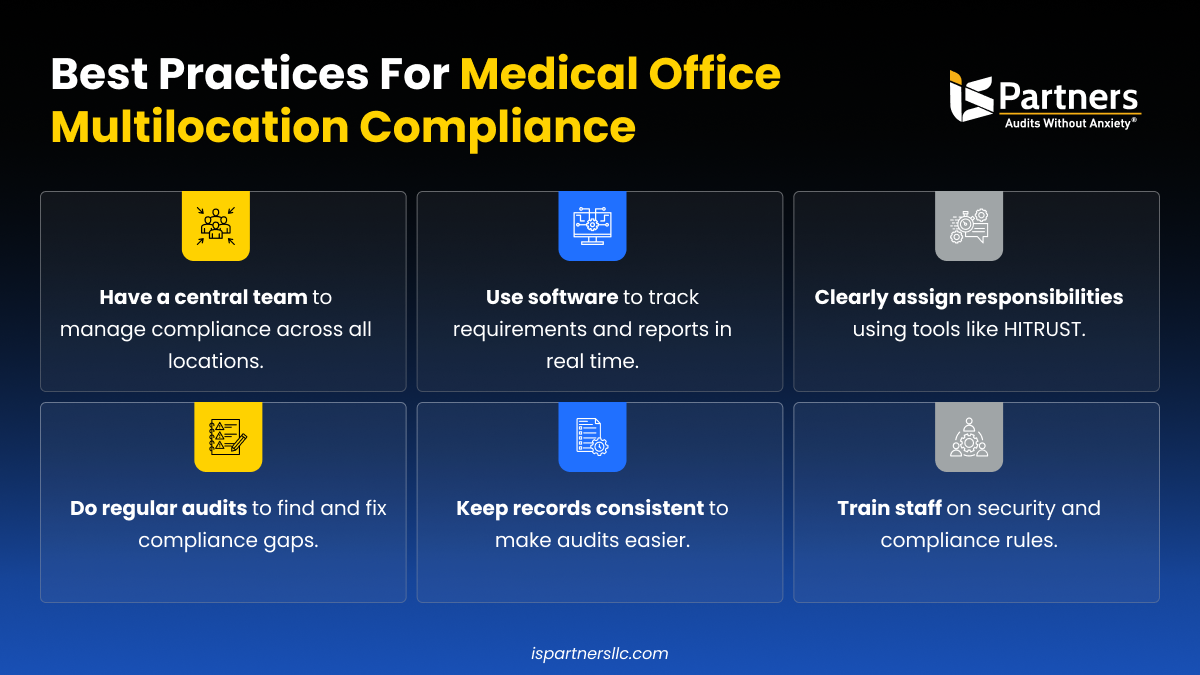
Some of the best practices to manage multilocation compliance and applicable laws are as follows:
- Create a central compliance team to manage policies, easy access, risks, and audits across all locations.
- Use compliance software to track requirements, controls, and reports in real-time.
- Map out responsibilities with tools like the HITRUST Shared Responsibility Matrix.
- Conduct regular audits to check for compliance gaps.
- Standardize reporting and documentation to make external audits easier.
- Train local teams and healthcare professionals on security best practices based on their specific risks.
IS Partners takes a holistic approach to security, focusing on understanding risks and how best to address them throughout an organization. “We ensure that security measures not only mitigate risks but also allow organizations to operate efficiently and effectively,” says Phil LaRocca, Director of Healthcare Compliance at IS Partners.
Our approach to HIPAA and HITRUST compliance is both efficient and patient privacy-focused, ensuring ongoing maintenance. We tailor the HIPAA risk assessment and audit process to fit your operations, providing solutions that align with your needs.
5 Benefits of Medical Office Multilocation Compliance
Here are five compelling reasons to prioritize multilocation compliance:
Standardized Compliance
Having the same rules and policies across all your locations makes life so much easier for everyone. Employees don’t have to stress about figuring out which rules apply where they’re working that day.
For example, if every site has the same HIPAA training programs for a culture of compliance and sanctions for non-compliance, staff can focus on their job instead of second-guessing themselves. It’s a win-win for productivity and peace of mind.
Regulatory Protection
No one wants to deal with the nightmare of fines, lawsuits, or a tarnished reputation. Following regulations like HIPAA, OSHA, and CMS as healthcare providers at every different location helps avoid these risks.
For example, if you skip a required OSHA patient safety protocol at one site, it only takes one audit or incident with medical records to create a major problem. The penalties can range from a few thousand to hundreds of thousands of dollars.
Building Patient Trust
Patients expect their information and care to be handled consistently and securely, no matter which location they visit. If one site has weaker compliance practices, it could erode that trust across your entire practice.
For instance, a patient might lose confidence if their data is mishandled at one location, even if others follow the rules perfectly. Consistency reassures patients and strengthens your reputation.
Ensuring Business Continuity
Audits, breaches, or non-compliance issues can disrupt operations and even shut down a location temporarily. When sticking to compliance protocols, you reduce the risk of these disruptions.
The impact of a data breach that halts operations at one site is not just costly but also damages patient trust and your practice’s reputation across other locations.

Simplify Multilocation Compliance with IS Partners
Managing compliance across multiple medical office locations is complex, but standardizing processes can mitigate risks, enhance efficiency, and protect patient data. Ensuring adherence to HIPAA, HITRUST, and other regulations at every site reduces the risk of fines, operational disruptions, and reputational damage.
At IS Partners, we specialize in simplifying multilocation compliance with full-scale audits, customized compliance roadmaps, and expert guidance. Our team helps medical practices streamline regulatory adherence, minimize administrative burdens, and maintain consistency across all locations.
What Should You Do Next?
Assess Your Compliance Status. Conduct an internal review to identify potential gaps in regulatory adherence across locations.
Implement a Standardized Framework. Develop uniform policies, training programs, and reporting systems to ensure consistency.
Partner with IS Partners. Work with our compliance experts to optimize your multilocation compliance strategy and reduce operational risks.
Don’t let compliance complexities slow you down. Contact IS Partners today to streamline your medical office’s multilocation compliance.
FAQs