


























Key Takeaways
1. The “HITRUST SR” stands for “HITRUST Shared Responsibility,” a program within the HITRUST framework that enables organizations to inherit existing security controls from their cloud providers or other third-party vendors.
2. The HITRUST Shared Responsibility Matrix (SRM) on the other hand helps define and document responsibilities between companies and their third-party providers, like cloud services or IT vendors.
3. IS Partners provides expert assessments and auditing services to simplify the process and support you need to achieve HITRUST certification.
What Is the HITRUST Shared Responsibility Matrix?
The HITRUST Shared Responsibility Matrix (SRM) is a practical resource designed to clarify and document the allocation of responsibilities for implementing and managing controls in a shared environment.
For example, the matrix specifies whether the responsibility for a particular control lies within the organization, the third-party provider, or both (shared responsibility).
Moreover, it allows the organization to inherit applicable controls from third-party providers like the cloud service provider.
How Does the HITRUST Shared Responsibility Matrix Work?
The HITRUST SRM is designed to help organizations and their third-party providers work together on security and compliance. It clearly defines who is responsible for what and makes the process more efficient and transparent.
Assigning Responsibilities
Achieving HITRUST certification requires a clear understanding of security responsibilities. The HITRUST SRM simplifies this process by categorizing controls, ensuring organizations and their providers know exactly what they are accountable for.
- Organization Owned Controls. Fully managed by the organization.
- Provider Owned Controls. Handled entirely by a third-party provider.
- Shared Controls. Both the organization and provider play a crucial role in the implementation and maintaining it.
Inheriting Existing Controls
One of the biggest advantages of the SRM is that organizations can inherit controls already implemented by their providers. For example, if a cloud provider already has strong cloud data encryption in place, the organization doesn’t need to build it from scratch. Instead, they can leverage that existing sensitive information security, reducing effort and compliance workload.
Simplifies Compliance
The SRM aligns with the HITRUST CSF framework, ensuring organizations meet compliance standards development without unnecessary duplication of work. It maps out responsibilities, that a company can focus only on the controls they truly need to manage.
Improving Collaboration and Security
Security is a team effort, especially in shared environments. The SRM ensures that no control is overlooked and that both parties, organizations, and their providers, are accountable for their roles. This strengthens security and prevents confusion and miscommunication.
Key Components of the HITRUST Shared Responsibility Matrix
The HITRUST SRM is built around core elements that help organizations and their third-party providers define, allocate, and manage security responsibilities. Here are the key components:
- Control Ownership Categories. Each security control is assigned to one of three categories Organization-Owned Controls, Provider-Owned Controls, and Shared Controls.
- Inheritable Controls. Organizations can reuse security measures already implemented by their providers, reducing effort.
- HITRUST CSF Alignment. The matrix is mapped to the HITRUST CSF to ensure compliance with industry standards and regulatory requirements like HIPAA, GDPR, and NIST.
- Responsibility Mapping. For shared controls, the matrix outlines what tasks each party must complete to ensure full security coverage.
- Documentation & Verification. Both organizations and providers must document their responsibilities and provide proof of implementation for audits and accountability.
Why Was the HITRUST SRM Developed?
In 2019, HITRUST recognized the confusion many organizations faced in determining how security responsibilities were divided between themselves and their cloud providers.
To address this, HITRUST partnered with AWS Managed Services and Microsoft Azure, two of the largest cloud providers globally, to create tailored Shared Responsibility Matrices for their services.
By 2021, HITRUST will make these resources publicly available, aligning each SRM with the specific offerings of each cloud security provider.
What Makes the HITRUST SRM Stand Out?
The SRM program sets a high bar for quality and credibility. Only 14 organizations worldwide have successfully published a HITRUST SRM. This reflects the rigorous qualification and validation process required.
Is the HITRUST Shared Responsibility Matrix a Requirement?
Strictly speaking, no. The SRM is not a mandatory requirement from HITRUST. However, it’s an invaluable tool for organizations using cloud services like AWS or Azure to manage their HITRUST certification responsibilities effectively.
The matrix clearly defines which security controls are handled by the cloud provider and which are the customer’s responsibility. Hence, making it a highly recommended resource for a successful HITRUST implementation.
Moreover, the latest version, SRM v1.4.2, supports assessments under the HITRUST Common Security Framework (CSF) v11.2 while maintaining compatibility with earlier versions (v9.1 through v11.2). This version helps organizations:
- Trace cross-version lineage between HITRUST CSF requirements.
- Manage the inheritability of control statements, especially when moving between v9.x and v11.x HITRUST CSF assessments.
Benefits of the HITRUST SRM
The SRM full version’s primary benefit is its ability to eliminate confusion around regulatory compliance responsibilities. It provides organizations with a clear, detailed understanding of what tasks they need to handle versus what their cloud provider manages. Some of the benefits for the end user are:
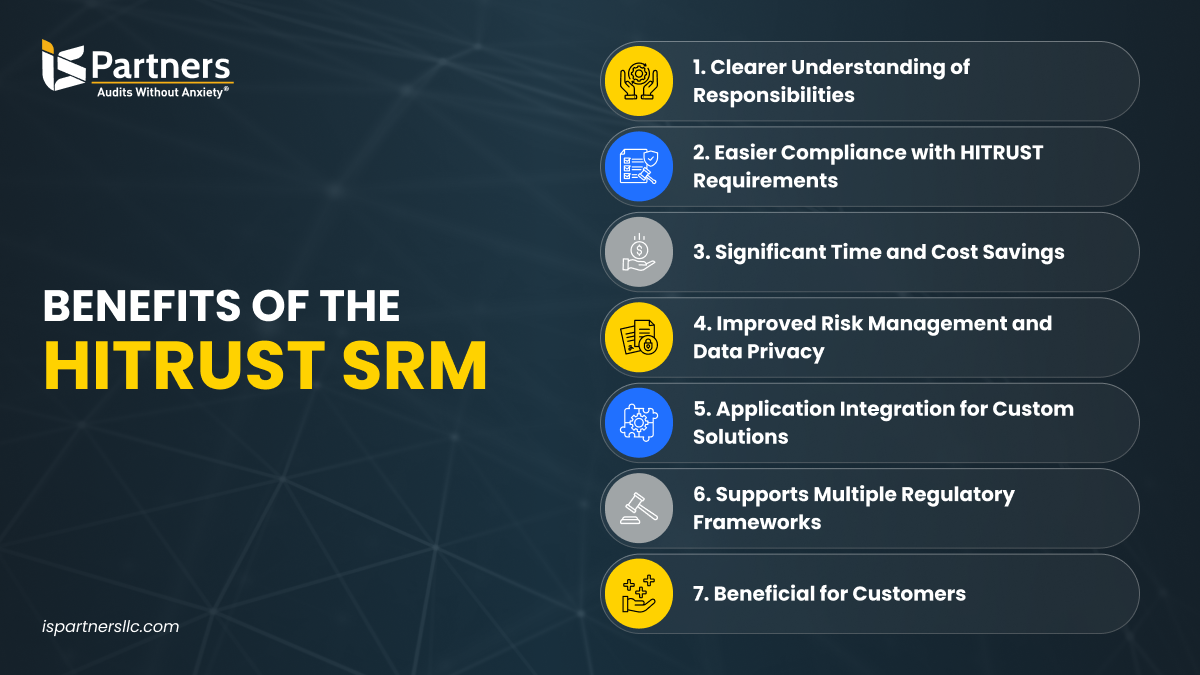
1. Clearer Understanding of Responsibilities
Managing security compliance comes with a lot of confusion, especially when responsibilities are split between the customer and the cloud provider. The HITRUST SRM provides a clear breakdown of who handles what. For example:
- The cloud service provider outlines the controls it manages (e.g., infrastructure security, and data protection operations).
- You know which controls are your responsibility (e.g., access permissions, specific application configurations).
This clarity reduces the risk of gaps for the assessed entity in compliance and ensures both parties fulfill their obligations.
2. Easier Compliance with HITRUST Requirements
Instead of manually reviewing the cloud service provider’s audit reports for controls like SOC 2 Type 2, the SRM allows you to inherit pre-validated controls directly. This means:
- You don’t need to waste time re-verifying CSP’s compliance efforts.
- Auditors can trust these pre-tested controls, simplifying your own HITRUST assessment process.
In short, the SRM removes much of the repetitive work involved in compliance.
3. Significant Time and Cost Savings
When you use the SRM inheritance, you can reduce the effort, time, and costs involved in your external HITRUST assessments for HITRUST CSF certification. Here’s how:
- The HITRUST MyCSF portal lets you pull in the CSP’s approved controls, skipping the need for independent verification.
- This process can cut down hours of documentation review and auditing, allowing you to focus on other priorities.
4. Improved Risk Management and Data Privacy
The HITRUST SRM ensures your compliance framework is aligned with CSP’s validated security measures. This means:
- You can build trust with stakeholders, knowing that data privacy and cybersecurity risks are minimized with effective risk management programs.
- The CSP’s rigorously reviewed controls serve as a foundation for your compliance, making your organization’s security posture stronger.
5. Application Integration for Custom Solutions
If you’re building applications or integrating a CSP into your processes, the SRM supports compliance at every stage.
- You can incorporate CSP’s inherited controls into your applications so that they meet end-to-end alignment with the AWS HITRUST Shared Responsibility Matrix.
- This is especially useful for businesses leveraging the target CSPs as a critical part of their operations, such as customer relationship management or data analysis.
6. Supports Multiple Regulatory Frameworks
The HITRUST SRM is not just targeted towards HITRUST CSF; it supports multiple compliance frameworks like HIPAA compliance, ISO 27001, and NIST to mitigate security issues.
- The chosen CSP’s controls are designed to meet these standards, and you can inherit them for your compliance efforts.
- This simplifies adhering to overlapping regulations, saving you from duplicating compliance work for different standards.
7. Beneficial for the Customers
The HITRUST SRM version 1.4.2 makes compliance easier by helping organizations clearly understand which security tasks they can “inherit” from any other CSP. It includes tools like the Cross Version ID (CVID) and Baseline Unique ID (BUID) that let you pick the right security controls, even if you’re using older versions of HITRUST standards.
Basically, the additional benefit for your customers is that instead of doing all the security checks yourself, you can use the controls the CSP has already validated. This saves time and money because your auditors can directly rely on the CSP’s work through the MyCSF portal.

Simplify HITRUST Compliance with the SRM and IS Partners
Managing security and compliance in a shared cloud environment can be complex, but the HITRUST Shared Responsibility Matrix (SRM) simplifies the process by clearly defining control ownership. This ensures organizations understand which responsibilities lie with them, their cloud providers, or both.
At IS Partners, we help businesses navigate HITRUST compliance, leveraging the SRM to streamline assessments, reduce redundant work, and improve security coordination. Our experts provide tailored HITRUST assessments, ensuring that your organization meets compliance requirements efficiently while maximizing the benefits of inherited controls.
What Should You Do Next?
Expedite your HITRUST compliance and certification process by properly using the SRM and guidance from experts.
Evaluate Your Compliance Needs. Identify which security controls apply to your organization and how the SRM can help you optimize compliance efforts.
Leverage Inherited Controls. Use pre-validated controls from your cloud provider to save time and resources during your HITRUST certification process.
Partner with IS Partners. Our team of compliance experts will guide you through HITRUST certification, ensuring security, efficiency, and regulatory alignment.
Don’t let compliance complexities slow you down—contact IS Partners today to simplify your HITRUST certification process!
FAQs