






Why Was HITRUST Created? Understanding the Meaning Behind the Framework

December 18, 2025



 Ensure financial data security for clients and partners.
 Save you time and money by ensuring you're fully prepared for your SOC 2 audit.
 Prove to your customers & vendors that you handle their data securely.
 Prove your commitment to cybersecurity and assure customers their data is secure.
 Demonstrate commitment to security through the service organization’s controls.
 Build a secure and transparent supply chain by complying with SOC standards.
 Strengthen operational resilience from cyber threats.
 Protect customer data, reduce the risk of penalties and safeguard your reputation.
 Enhance security, reduce risk, and increase trust with stakeholders.
 Improve financial transparency, reduce accounting fraud, and enhance investor confidence.
 Future proof your business by Identifying, assessing, and mitigating AI-related risks.
 Identify network vulnerabilities and entry points that attackers could exploit.
 Gain access to government contracts by proving you're serious about security.
 Identify vulnerabilities and entry points in the cloud that attackers could exploit.
 Identify vulnerabilities with your human team that hackers could manipulate and exploit.
 Identify, analyze and evaluate potential risks to your organization data security.
 Validate your company's cloud-specific security controls and demonstrate a commitment to data security.
 Protect against common cyber threats and demonstrate baseline security.Future proof your business by Identifying, assessing, and mitigating AI-related risks.
 Establish and advance your organization’s AI Management System to ensure secure and responsible AI governance.
 Demonstrate your commitment to innovation through the adoption of secure, responsible, and ethical Al practices.
 Reduce the risk of legal and financial penalties and increase trust in your brand.
 Meet compliance regulations set by the New York Department of Financial Services.
 Meet compliance regulations set by the European Union's General Data Protection Regulation.
 Ensure data privacy compliance with expert oversight.Prove to your customers & vendors that you handle their data securely.
 Protect sensitive data by enhancing cybersecurity and reducing risk.Gain access to government contracts by proving you're serious about security.Enhance security, reduce risk, and increase trust with stakeholders.
 Protect sensitive information from hackers and security threats, ensuring your data stays safe.
 Checkout our latest blogs on compliance frameworks and security.
 Checkout our FREE tools to learn more about managing compliance.
 Learn about how Checklists & Templates for compliance programs.
 Join us for events to stay informed and ahead in compliance.
 Everything you need to know about compliance frameworks in one place.
 Join 10,000 others who receive our award-winning content in their inbox each month.
 HITRUST AI RM Knowledge Hub / Post-Implementation / Updating Policies Based on Evolving Regulations and Risks
 New regulations emerge every year. Hence, as a responsible company using AI, you need to update your policies whenever they change.
The process is simple here. You must review your existing policies, make necessary updates, and ensure version control so everyone works with the latest guidelines.
In some cases, entirely new policies may be needed to cover risks that weren’t previously considered.
Take a look at the image below to understand how regulations evolve now and then.
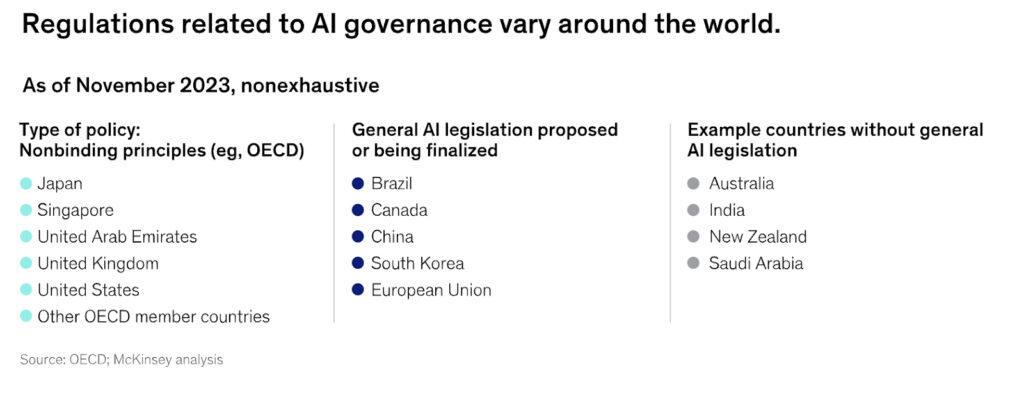
AI risk doesn’t operate on a set schedule, but regulatory updates do. Establish a structured review process, whichever you’re comfortable with (quarterly, biannually, or as new regulations emerge), to ensure your AI policies stay current.
AI systems evolve, and so do their risks. That’s why blindly updating policies without identifying potential gaps is risky. Instead, take a proactive approach:
Maintaining a version-controlled record of AI policies and system updates helps teams stay aligned and makes it easier for new members to get up to speed quickly. It also provides visibility into any points of failure or past challenges, aiding in the early identification of potential vulnerabilities.
A policy is only as good as the people following it. If your teams don’t understand AI governance updates, even the best policies won’t make an impact.
To maintain an effective AI strategy, rising threats and regulatory changes must be monitored. This final step requires you to designate a specific individual or a specialized team to track AI advancements continually. The team must also integrate relevant innovations or safeguards into the organization’s systems and policies.


Fill out the form to schedule a free, 30-minute consultation with a senior-level compliance expert today!
Benefit from:

Great companies think alike.
Join hundreds of other companies that trust IS Partners for their compliance, attestation and security needs.